

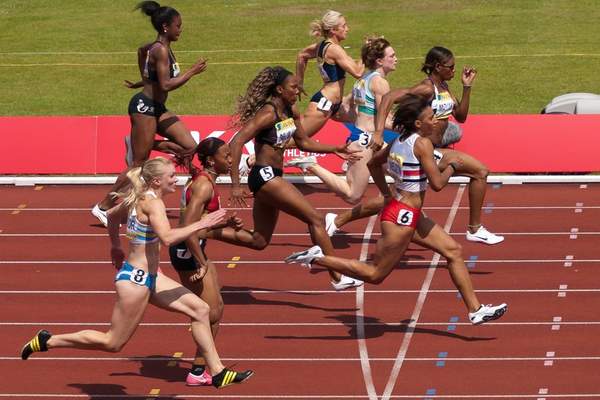
A faster 100 meters is not built from one magic cue. The race is a sequence: block position, an explosive but organized start, progressive acceleration, upright maximum-velocity mechanics, and the ability to hold form as fatigue appears. Good 100 meter sprint technique connects those phases smoothly. If one phase is rushed or forced, the next usually suffers.
Build the Race From the Start Position
Your block setup should let you push hard without feeling cramped or stretched. Exact spacing varies with leg length and preference, so there is no universal measurement. A useful starting point is a front knee near a right angle in the set position, with the rear knee more open. Small adjustments can then be made from comfort and video feedback.
Place the hands just behind the line, roughly shoulder-width apart. In the set position, raise the hips above the shoulders while keeping the spine neutral and the head in line with the torso. The shoulders should sit slightly forward of the hands.
Think Push, Not Pop Up
The first movement should be a forceful push from both blocks, not an attempt to stand upright immediately. Effective block start technique sends the body forward. The opening steps are naturally short and powerful because the athlete is still projecting horizontally.
A useful cue is “push the track away.” It encourages extension through the hip, knee, and ankle while reducing the temptation to reach forward with the foot. The foot should contact close to the body’s moving center of mass rather than far out in front.
Use Progressive Sprint Acceleration
Acceleration is not a body angle you hold for a fixed number of steps. It is a gradual transition. Early in the race, the torso is inclined because the athlete is still building speed. As velocity rises, the body moves naturally toward a taller sprint posture.
Trying to stay artificially low can make an athlete bend at the waist. Standing up too early creates the opposite problem by reducing the horizontal force that matters in the opening steps. Good sprint acceleration changes posture progressively.
Drive the arms decisively from the shoulders with relaxed hands. Avoid excessive crossing in front of the torso. Fast sprinting depends on rhythm, and unnecessary side-to-side motion wastes energy.
Clean Up Your 100m Sprint Form
As you reach upright running, the emphasis shifts toward applying large forces during very brief ground contacts. The torso becomes tall, the hips stay high, and the legs cycle rapidly beneath the body.
At top speed, avoid deliberately reaching forward with the lower leg. Overstriding creates braking because the foot contacts too far ahead of the body. Instead, think about stepping down quickly beneath you. The thigh can rise naturally, but forcing exaggerated knee lift often adds tension rather than speed.
Strong top speed mechanics also depend on efficient recovery. After ground contact, the leg should return forward quickly instead of trailing too long behind the body. The heel folds toward the body, the thigh comes forward, and the foot prepares for the next contact.
Relaxation Is a Speed Skill
Maximum effort does not mean maximum tension. Tight shoulders, clenched fists, or a rigid jaw can disrupt rhythm. Keep the face relaxed, the hands loose, and the shoulders free.
Notice what happens in the final 30 meters. If your shoulders rise and your stride becomes noisy or reaching, you may be fighting the race. Stay tall, keep the hips moving forward, and maintain quick contact with the track.
Use Video to Find the Real Problem
Common sprint mistakes are often symptoms of something earlier in the race. If an athlete reaches with the foot at 60 meters, the cause may be excess tension or poor posture. If the athlete pops upright on step two, the issue may begin with block angles or the first push.
Video helps because sprinting happens too quickly to judge accurately by feel alone. Record starts and flying sprints from the side, ideally at a high frame rate. Check posture, where the foot lands relative to the hips, and whether the transition to upright running looks gradual.
Useful internal topics to explore next include sprint acceleration drills, maximum-velocity training, and starting-block setup.
Practice Technique at a Speed You Can Control
Technical work should be fast enough to resemble sprinting but controlled enough to repeat good positions. Short accelerations of 10 to 30 meters are useful for starts. Flying sprints, where you build speed before entering a focused zone, are valuable for upright mechanics.
For an athlete who rushes the first 20 meters, try four block starts over 10 meters with full recovery and one cue only: push hard without trying to stand up. Then perform three accelerations over 30 meters, allowing the torso to rise naturally. Finish with three flying 20-meter runs after a gradual build-up. Rest enough between repetitions to keep speed and technique high.
For race-specific practice, keep technical cues simple. Choose one priority for each repetition, then review the result afterward. Clear feedback works better than carrying several instructions into a sprint where decisions must happen almost instantly.
Measure Whether Your Technique Is Improving
Do not judge progress only by feel. Track useful markers such as 10 meters from blocks, 30 meters from a start, or a flying 20 meters. Compare video under similar conditions. Several better repetitions with cleaner mechanics tell you more than one unusually fast effort.
Technique should also survive higher intensity. A drill that looks perfect at jogging speed has limited value if the same positions disappear during sprinting. The aim is to transfer efficient movement into fast running.
Frequently Asked Questions
How long should I stay low in a 100-meter sprint?
Do not force a predetermined low position. Stay in a strong acceleration posture while building speed, then allow the body to rise gradually. There is no single correct step count for every sprinter.
Should I land on my toes when sprinting?
Think about an active contact underneath the body rather than trying to point the toes. Fast sprinting usually involves contact toward the front or middle of the foot, but forcing a toe-only landing can create unnecessary tension.
How can I stop overstriding?
Focus on tall hips, quick downward foot action, and relaxed mechanics. Video can confirm whether the foot is landing too far ahead of the hips. Flying sprints and rhythm drills can help reinforce better spacing.
How often should I practice sprint technique?
Quality matters more than volume. Technique can be included in speed sessions several times per week depending on training age, workload, and recovery. Full-speed work needs generous rest so fatigue does not turn technical practice into slow, strained running.
Put the Phases Together
The best 100 meter sprint technique is a connected sequence rather than a collection of isolated poses. Set the blocks so you can push powerfully, project forward at the gun, let acceleration unfold gradually, rise into tall and elastic top-speed mechanics, and stay relaxed as the finish approaches. Work on one or two cues at a time, use video and split times to check progress, and give fast repetitions enough recovery. When each phase supports the next, speed becomes easier to express instead of something you have to force.
