

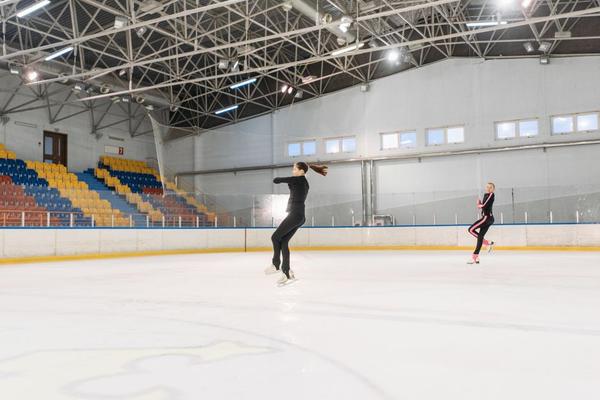
A skater glides backward, taps the ice, rises into a tight spin and lands on one foot. To an unfamiliar viewer, many jumps look almost identical. The key to telling them apart happens before the skater leaves the ice. Each of figure skating’s six recognized jump types has a particular takeoff edge, direction or toe-pick action.
Once you know what to watch for, figure skating jumps become easier to identify without counting every airborne revolution. Here is how the toe loop, Salchow, loop, flip, Lutz and Axel differ.
Two families of figure skating jumps
Every skate blade has an inside edge, nearest the other foot, and an outside edge, farther from it. A skater can travel forward or backward on either edge. The edge used just before takeoff is central to a jump’s identity; the landing alone usually will not tell you which jump you saw.
Three jumps are edge jumps: the Salchow, loop and Axel. Their takeoffs rely on a skating edge without a toe pick planted by the free foot. The other three are toe-assisted jumps: the toe loop, flip and Lutz. For these, the free foot’s toe pick helps propel the skater into the air. For the vocabulary of blade control, explore figure skating edges and turns.
The six main figure skating jump types
Toe loop: backward outside edge with toe assistance
The toe loop jump starts from a backward outside edge. The skater reaches back with the free foot, plants its toe pick and vaults upward. For a skater rotating counterclockwise, the skating foot is typically the right foot and the picking foot is the left.
Toe loops frequently appear as the second jump in combinations because the preceding jump typically lands on the backward outside edge needed for takeoff. Although the moves flow together, the skater lands and takes off separately for each jump.
Salchow: launched from a backward inside edge
The Salchow takes off from a backward inside edge without assistance from the free foot’s toe pick. Often, the free leg swings around as the skater rises, helping organize the rotation. In the common counterclockwise version, takeoff comes from the left foot and landing from the right.
Look for the curved backward entry and smooth sweep of the free leg. A Salchow may resemble a toe loop at full speed, but the absence of a planted toe pick is decisive.
Loop: takeoff and landing on the same foot
The loop is another edge jump, but it begins on a backward outside edge and lands on the backward outside edge of the same foot. A counterclockwise skater commonly takes off and lands on the right foot, making it distinctive among the six jumps. The free leg often crosses in front during preparation.
Flip: a toe-assisted backward inside-edge jump
The flip uses a backward inside edge and a toe-pick plant by the opposite foot. A counterclockwise skater commonly glides on the left backward inside edge and reaches back with the right toe pick. A three-turn or other steps may set up the entry.
Its close relative is the Lutz. Both are toe-assisted and commonly land on the same backward outside edge, so judging the takeoff edge is essential. A flip should come from the inside edge, not the outside edge.
Lutz: a toe-assisted backward outside-edge jump
The Lutz jump takes off from a backward outside edge while the opposite foot’s toe pick assists. Its entry is counter-rotational: the skater maintains a curve that works against the intended direction of airborne rotation. That control makes a clean Lutz particularly demanding.
For counterclockwise rotation, the skater typically approaches on the left backward outside edge and picks with the right foot. A Lutz often follows a long backward glide, but rink position alone cannot identify it. Shifting toward an inside edge can lead to an edge-related judging call.
Axel: the only jump that takes off forward
The Axel jump stands apart because its takeoff is from a forward outside edge. The skater then lands backward, like the other jumps. That change in direction adds half a revolution: a single Axel has one and a half airborne rotations, a double has two and a half, and a triple has three and a half.
For a counterclockwise skater, the usual takeoff is from the left forward outside edge, followed by a landing on the right backward outside edge. If you see an unmistakable forward-facing launch, suspect an Axel first.
How to recognize jumps while watching a routine
Try watching a replay at reduced speed and pausing immediately before takeoff rather than at the peak of the jump. First ask whether the skater is traveling forward. A forward outside-edge launch points to an Axel. If the skater is backward, look for a toe-pick plant to separate toe-assisted jumps from edge jumps.
Next, trace the takeoff curve. For a toe-assisted jump, a backward outside edge indicates a toe loop or Lutz; the skating foot and entry distinguish them. A backward inside edge indicates a flip. Among edge jumps, an inside-edge takeoff suggests a Salchow, while a backward outside-edge takeoff suggests a loop.
This method works whichever way an athlete rotates. Left and right reverse for clockwise skaters, but forward versus backward and inside versus outside remain the same. Basic figure skating footwork is another useful topic for understanding the setups.
Singles, doubles, triples and why landings matter
A jump name describes takeoff technique; single, double, triple and quadruple describe rotation count. The Axel is the exception to the whole-number pattern because its forward takeoff adds a half turn. A triple Lutz and a single Lutz therefore share a jump family despite very different rotational demands.
Most standard jumps land on a backward outside edge with one foot. Judges and technical officials look beyond whether the skater stays upright: rotation at landing, takeoff edges on flips and Lutzes, execution quality and other technical rules can influence the score. A seemingly landed jump may still receive a rotation or edge call. Figure skating scoring basics can help explain why.
Frequently asked questions
What are the six main jumps in figure skating?
They are the toe loop, Salchow, loop, flip, Lutz and Axel. Salchow, loop and Axel are edge jumps; toe loop, flip and Lutz use toe-pick assistance.
What is the difference between a flip and a Lutz?
Both use a toe pick, but the flip takes off from a backward inside edge while the Lutz takes off from a backward outside edge. The Lutz’s counter-rotational approach adds another challenge.
Why does an Axel have an extra half rotation?
The Axel launches forward but lands backward. Its single, double and triple versions therefore rotate one and a half, two and a half, and three and a half times respectively.
Which figure skating jump is the hardest?
There is no universal answer for every skater. Difficulty depends on rotation count and individual technique. Axels are especially challenging because of their forward takeoff, while Lutzes demand precise outside-edge control.
Final thoughts
Watch the takeoff edge, the toe pick and the launch direction rather than the blur of midair rotation. Those clues reveal the distinct skills behind figure skating’s six jumps.
