

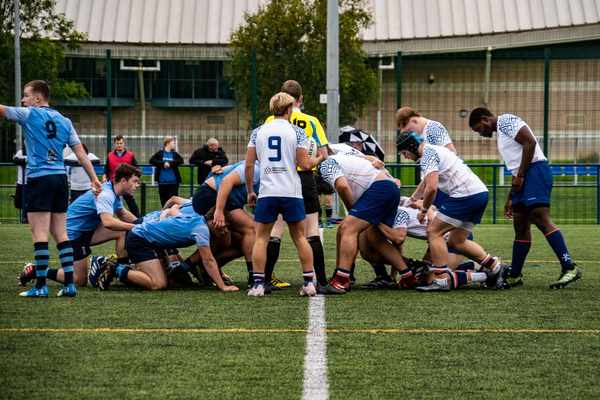
To a new rugby fan, a scrum can look like sixteen forwards simply pushing against one another. In reality, every stage is regulated: who packs down, when the players engage, how the ball enters and where defenders may stand. Rugby scrum rules turn that collision of strength into a structured contest for possession.
A scrum can also shape an attack. It may provide clean ball for the backs, force an opponent into a penalty or create room for a number eight to break away.
When Is a Scrum Awarded?
A scrum restarts rugby union after various minor infringements or stoppages. A knock-forward or forward pass generally gives the non-offending team the put-in. An unplayable ruck, certain unsuccessful mauls or a team’s choice after winning a penalty can also lead to a scrum.
The referee marks the position within the scrum zone. Teams must be ready within 30 seconds. Although the feeding team enjoys an advantage, the opposition can still win possession legally.
Scrum Positions Explained
The front row
In standard 15-a-side rugby, each team supplies eight forwards. The loose-head prop, hooker and tight-head prop form the front row. Props support the hooker and contest pressure against their opponents. The hooker strikes for the ball with a foot after it lands in the tunnel.
The other five forwards
Two locks bind behind the front row and help drive the pack. Flankers occupy the sides, while the number eight anchors the back. The number eight may control the ball at the rear or pick it up to attack. Players throughout the pack must maintain their prescribed binding.
Age-grade competitions and modified formats may apply different scrum numbers and safety restrictions. Rugby sevens, for instance, uses three players per side.
How Rugby Scrums Work: Crouch, Bind, Set
The referee manages a safety-focused engagement sequence. Both packs must be square, stable and stationary for each call.
Crouch
Front-row players lower their bodies with heads and shoulders no lower than their hips. Each hooker uses a brake foot to stabilise the formation and limit dangerous pressure during setup.
Bind
Opposing props take the prescribed grip on the back or side of each other’s jerseys. They must maintain that binding throughout the scrum; releasing it or pulling an opponent can result in a penalty.
Set
On the set call, hookers withdraw their brake feet and the packs engage to create the tunnel. They cannot charge together early. Critically, the forwards may only start pushing when the ball leaves the scrum-half’s hands.
How Is the Ball Put Into a Scrum?
The scrum-half awarded the feed chooses the side of the scrum. Once the packs are stable, the ball must be delivered promptly, quickly and in a single forward movement, touching the ground first inside the tunnel.
The feed must be straight, but the scrum-half may align a shoulder with the middle line, permitting a limited offset. This does not authorise rolling the ball straight towards the feeding team’s back row.
The feeding hooker must strike for the ball. Front-row players may strike only after it touches the ground and cannot use both feet simultaneously. Inside the scrum, players move the ball with their feet or lower legs, not their hands.
Possession commonly travels towards the number eight. The scrum-half can then pass, or the number eight may pick up. If a stationary scrum has the ball available at the back for several seconds, the referee calls “use it” and the team must play it immediately.
Legal Pushing and Scrum Offside
Teams may drive forward only in a straight line, parallel to the ground. They must not deliberately collapse the scrum, lift opponents or pull players out of position. Safe technique matters more than which pack appears stronger.
Players outside the scrum generally remain at least five metres behind the hindmost foot of their own pack. Near the try line, their offside line can instead be the try line. Scrum-halves have different positioning requirements.
Under the current scrum-half protection trial, a defending scrum-half who stays alongside the scrum cannot take both feet beyond the centre line of the tunnel. That player may instead retreat to a permitted offside position. The restriction gives the attacking scrum-half more room to distribute the ball.
A separate guide to rugby offside rules can help clarify how these restrictions differ from open play.
What Leads to Scrum Penalties and Free-Kicks?
Scrum penalties generally punish more serious infringements. Examples include deliberately collapsing, pushing at an angle, lifting an opponent, pulling a player, illegal binding and crossing a scrum offside line. A pack going backwards is not automatically at fault if the scrum collapses; the referee must identify the infringement.
Free-kicks cover several setup and technical mistakes. These include pushing before the feed, feeding incorrectly, failing to maintain the required brake foot, striking before the ball lands and the feeding hooker failing to strike. The distinction matters because a penalty offers different options from a free-kick.
For readers learning the wider game, an overview of rugby set pieces provides useful context for why a captain might choose a scrum.
When Does a Scrum Reset or End?
Without an identified infringement, the referee may reset a scrum that collapses, breaks up, wheels beyond 90 degrees or produces no winner. On a no-fault reset, the original team keeps the put-in.
The scrum ends when the ball emerges other than through the tunnel, is legally played or picked up from the rear in the circumstances allowed by law, reaches or crosses the try line, or the referee stops play. Seeing the ball beneath the number eight’s feet does not necessarily mean it is out.
A Practical Example Near the Try Line
Imagine an attacking scrum five metres from the try line. The hooker strikes the feed backwards, the pack drives straight, and the number eight holds the ball at the rear. If the defending scrum-half moves beyond the permitted tunnel position before the scrum ends, the referee may award a penalty. The key infringement is offside, not the direction of the push.
Frequently Asked Questions
Can a team win a scrum without feeding it?
Yes. The defending pack may hook the ball or push opponents away from it, provided the contest remains legal.
Does the feed have to be exactly down the middle?
It must be straight, although the feeding scrum-half may legally align a shoulder with the middle line.
Why do referees reset scrums?
Resets allow a fair contest to restart when the original scrum cannot continue and no infringement is identified.
Are scrums the same in rugby sevens?
No. Sevens uses three-player scrums and has variations from the standard 15-a-side scrum laws.
Reading the Scrum With Confidence
Watch the engagement calls, the instant the ball is fed, and the position of the defending scrum-half. Those three details explain many decisions. Once you recognise the technique and rules behind the pushing, a scrum becomes one of rugby union’s most revealing tactical contests.
